AI companions can be useful for conversation, reflection, and emotional support, but they work best when people treat them as tools, not replacements for real relationships. As these apps become more common, users need clear boundaries around time, trust, privacy, and emotional dependence.
Why AI companions are getting attention now
AI companions have moved from a niche tech idea into everyday apps. Some are built for friendly chats. Others are designed for romance, roleplay, coaching, or late-night emotional support.
That shift is why parents, researchers, lawmakers, and users are taking a closer look.
In 2025, Common Sense Media reported that 72% of teens had used AI companions, and half used them regularly.¹ The Federal Trade Commission also opened an inquiry into AI chatbots acting as companions, with a focus on children, teens, safety practices, and possible risks.²
The concern is not that every chatbot is harmful. The concern is that these tools can start to feel personal very quickly, especially when they remember details, respond warmly, and never seem too busy to answer.
1. Remember that AI companions are not people

This is the easiest rule to say and the hardest one to keep in mind.
AI companions can sound caring. They can ask follow-up questions. They can offer comfort at 1 a.m. when no one else is awake. But the system is still software. It is generating responses, not forming a real human bond.
OpenAI and MIT Media Lab studied emotional use of ChatGPT and found that user behavior, chat style, and length of use can all play a role in social and emotional outcomes.³ That does not mean every emotional chat is unsafe. It does mean users should notice how often they turn to AI for comfort.
Use AI companions to sort through thoughts, draft a message, or reflect on a rough day. Do not treat them as a replacement for friends, family, therapy, or medical care.
2. Set a time limit before you start
AI companions are always available. That is part of their appeal.
It is also part of the risk.
A quick check-in can turn into an hour of back-and-forth. The bigger issue is not just screen time. It is the habit of turning to AI first every time you feel lonely, stressed, bored, or unsure.
Set a limit before you begin. Ten or fifteen minutes is enough for most casual chats. When the time is up, close the app and do something outside the conversation. Send the text. Take the walk. Call the person. Move back into your actual life.
3. Keep private details private
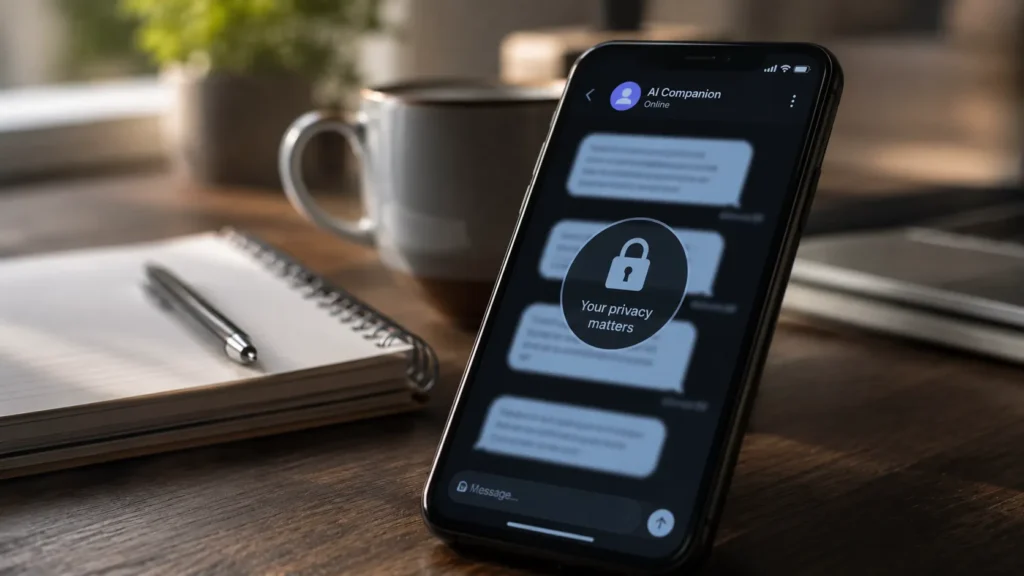
AI companions can feel personal, but users should still be careful with what they share.
Avoid entering passwords, financial information, workplace details, medical records, family conflict, or anything you would not want stored or reviewed later. Even when companies publish privacy policies, sensitive details still deserve extra caution.
This matters even more for younger users. The FTC said its inquiry is looking at how companies evaluate chatbot safety, limit possible effects on children and teens, and inform users and parents about risks.²
4. Watch for emotional dependence
AI companions can be comforting because they do not interrupt, get annoyed, or need anything from you. For someone having a bad night, that can be appealing.
But constant agreement can create a quiet problem.
Ask yourself this: Is this chat helping me deal with my life, or helping me avoid it?
If AI companions become the main place you process sadness, anxiety, conflict, or loneliness, it may be time to pull back. Real relationships are not always smooth, but they include accountability, shared history, body language, and care that does not come from a response system.
5. Be careful with romance and roleplay

Romantic AI companions are one of the most emotionally complicated parts of this trend.
Some people may see these chats as harmless. Others may start comparing real partners to a system designed to be agreeable, available, and attentive. That can create tension in dating, marriage, and friendships.
A good gut check is privacy. If you would feel the need to hide the chat from a partner, or if the app is replacing human connection, it is worth taking seriously.
6. Use AI companions as a starting point, not the final answer
AI companions can help you name what you are feeling, rehearse a hard conversation, or organize your thoughts before making a decision.
That does not mean they should make the decision for you.
Do not let AI companions decide whether you should end a relationship, quit a job, confront someone, stop medication, or make a major financial move. Use the chat to think more clearly, then talk to someone who understands your real situation.
7. Know when to step away

There are moments when AI companions are the wrong place to turn.
If you feel unsafe, overwhelmed, or worried you might hurt yourself or someone else, contact emergency services, a crisis line, or a trusted person right away. A chatbot may respond quickly, but it cannot sit beside you, call for help, or understand your full situation the way a trained person can.
Lawmakers are starting to focus on this issue. California’s SB 243, which took effect January 1, 2026, created new requirements for companion chatbot operators, including disclosures and safety protocols tied to self-harm risks.⁴
What many people miss about AI companions
The biggest risk is not that AI companions suddenly replace everyone in your life.
It is convenience.
It is easier to open an app than explain yourself to a friend. It is easier to talk to something that always answers than wait for a person who is busy. It is easier to get comfort without the awkwardness, tension, or vulnerability that comes with real closeness.
That does not make AI companions bad. It means they need boundaries.
Used carefully, they can help people reflect, write, think, and get through lonely moments. Used without limits, they can quietly pull attention away from the relationships that matter most.
Final thought
AI companions are becoming part of daily life, and the questions around them are not going away. The answer is not panic. It is awareness.
Use the tools when they help. Enjoy the convenience. But keep real people at the center of your life. The healthiest boundary may be this: let AI companions support your relationships, not replace them.
Citations
- Robb, Michael B. “Talk, Trust, and Trade-Offs: How and Why Teens Use AI Companions.” Common Sense Media, 16 July 2025.
- “FTC Launches Inquiry into AI Chatbots Acting as Companions.” Federal Trade Commission, 11 Sept. 2025.
- Phang, Jason, et al. “Early Methods for Studying Affective Use and Emotional Well-Being on ChatGPT.” OpenAI, 21 Mar. 2025.
- Nalaschi, Bianca. “Analyzing the New AI Companion Chatbot Laws.” Privacy + Cyber + AI, Troutman Pepper Locke, 8 Jan. 2026.