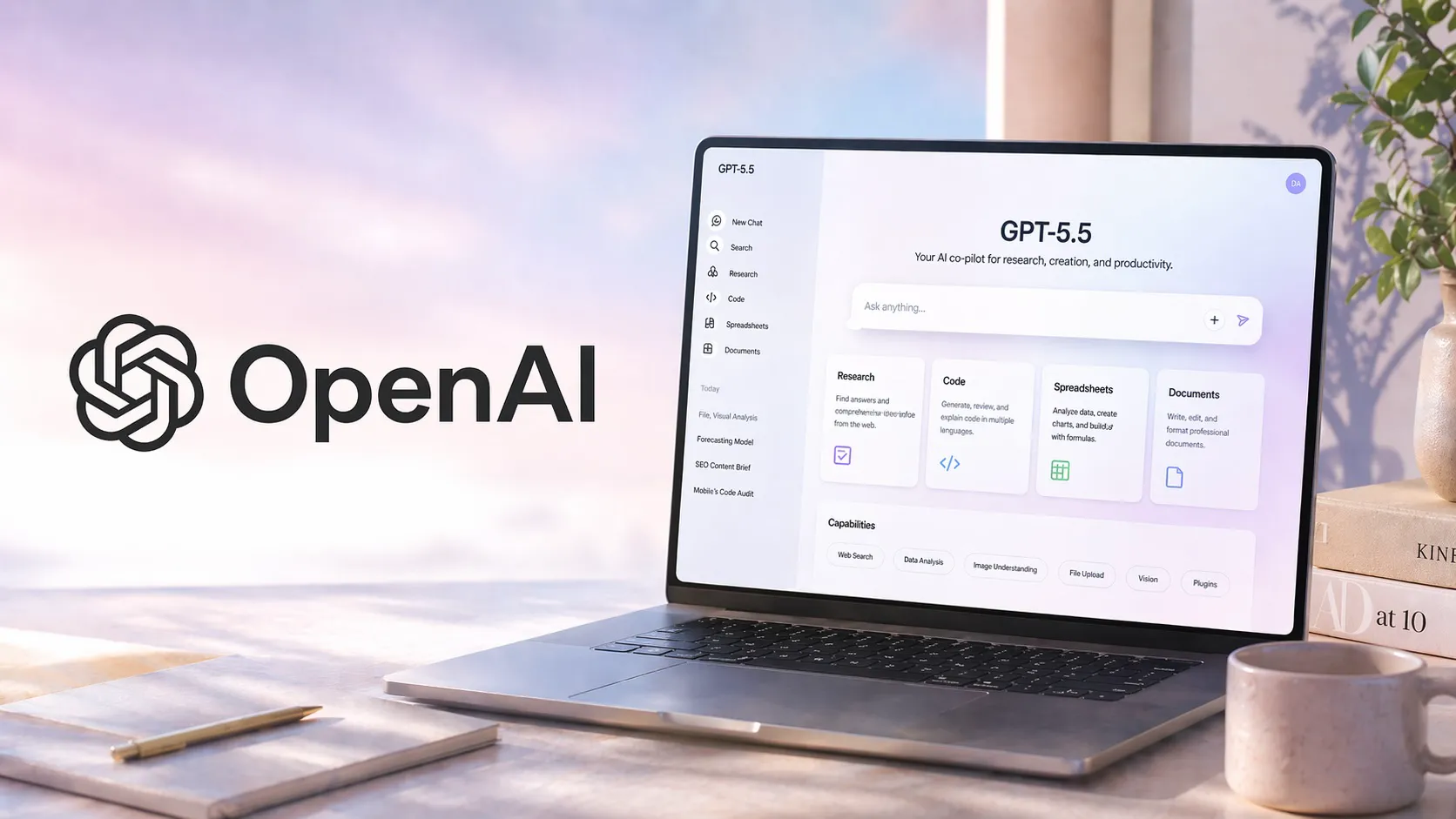
GPT-5.5 is OpenAI’s newest advanced model for ChatGPT, Codex, and the API. It is built for harder work, including coding, research, documents, spreadsheets, and longer tasks that need several steps. For ChatGPT users, the main change is better reasoning, stronger tool use, and less need to guide every move.¹
GPT-5.5 Brings ChatGPT Closer to Real Work
GPT-5.5 is not just a faster answer machine. OpenAI is framing it as a model for more complete work sessions.
That means the model is meant to handle tasks with several parts. It can review information, use tools, check its own work, and keep going until the request is finished. OpenAI says GPT-5.5 is designed for work such as coding, online research, data analysis, document creation, spreadsheets, and moving across tools.¹
For ChatGPT users, that matters because many prompts now look more like real assignments than short questions.
Someone might ask ChatGPT to compare three proposals, summarize a lease, clean up a spreadsheet, write a report, or review a resume against a job description. GPT-5.5 is built for that kind of work.
What Changed With GPT-5.5 in ChatGPT
The biggest change is how much of a task the model can carry on its own.
OpenAI says GPT-5.5 understands what a user is trying to do earlier, asks for less guidance, uses tools more effectively, checks its work, and keeps going longer than earlier models.²
That does not mean it will be perfect. It means ChatGPT should be better at handling messy requests where the user gives a goal, a few rules, and some source material.
The Model Picker Matters More Now
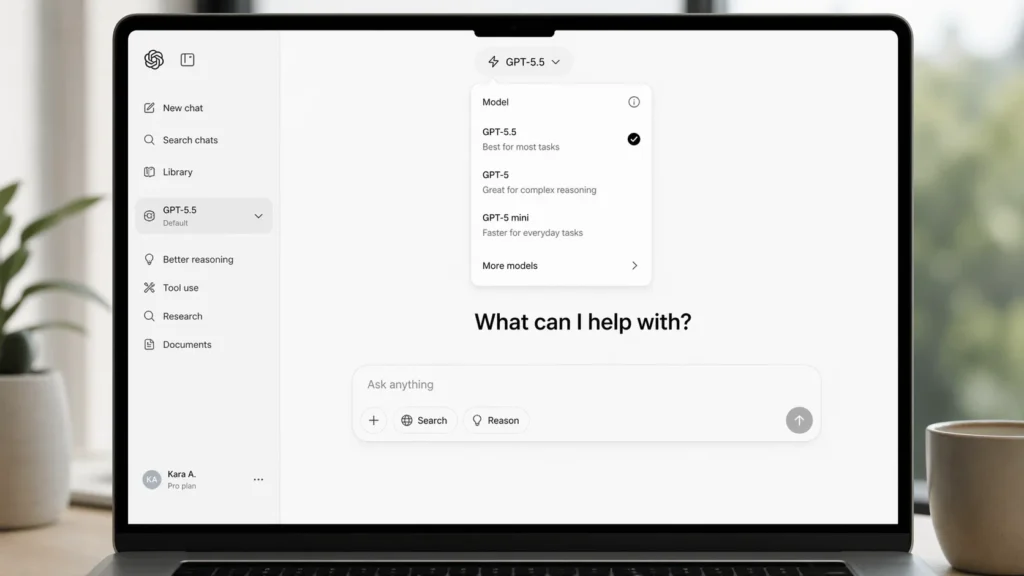
In ChatGPT, GPT-5.5 appears through Thinking mode for deeper reasoning. OpenAI’s help page says access and usage limits depend on the plan, and some users may see different options during rollout.³
That makes the model picker more important. Faster models may still be better for quick answers. GPT-5.5 is the better fit when the task is harder, longer, or needs careful review.
There is also GPT-5.5 Pro, which OpenAI says is meant for tougher questions and higher-accuracy work.¹ But Pro mode has tradeoffs. OpenAI’s help page notes that some ChatGPT tools, including Apps, Memory, Canvas, and image generation, are not available in Pro mode.³
Why People Are Paying Attention Now
The interest around GPT-5.5 is not only about a new model name. It points to a bigger change in how people use AI.
ChatGPT started as a place to ask questions. Now many users treat it as a workspace. They upload files. They ask for edits. They request research. They compare options. They want a finished draft, table, plan, or explanation.
GPT-5.5 fits that shift.
A marketer could use it to review campaign results and draft next steps. A small business owner could use it to compare vendor bids. A job seeker could use it to improve a resume without adding false claims. A student could use it to organize notes and spot gaps before studying.
The value is not that it replaces judgment. It saves time on the parts that slow people down: sorting, comparing, drafting, checking, and organizing.
GPT-5.5 for Developers and Codex Users
Developers also get important changes.
OpenAI’s API changelog says GPT-5.5 is available in the Chat Completions, Responses, and Batch APIs. GPT-5.5 Pro is available for Responses API requests that need more compute.⁴
OpenAI’s model page lists GPT-5.5 with a 1,050,000-token context window.⁵ In regular terms, that gives developers much more room to work with long documents, large codebases, and large sets of instructions.
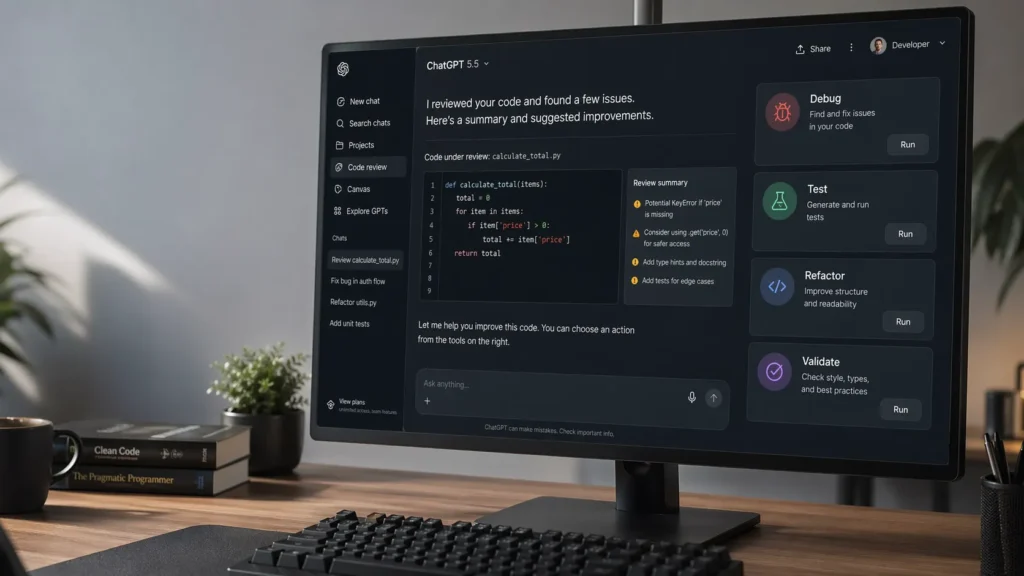
Codex users get a direct upgrade too. OpenAI says GPT-5.5 is now available in Codex and is recommended for many coding tasks when it appears in the model picker. It is especially useful for implementation, refactors, debugging, testing, validation, and knowledge-work materials.⁶
What ChatGPT Users Should Be Careful About
GPT-5.5 is stronger, but it still needs review.
A confident answer can still miss context. A summary can still leave out an important detail. A legal, medical, financial, or technical answer should still be checked before anyone acts on it.
Users should also remember that access depends on the plan and rollout. Not everyone will see GPT-5.5 in the same place at the same time.³
The best way to use GPT-5.5 is to give it a clear goal, the source material, the rules it must follow, and the format you want. Then read the final result closely.
What GPT-5.5 Means Going Forward

GPT-5.5 shows where ChatGPT is heading. The focus is moving from quick replies to longer tasks that need context, care, and follow-through.
For users, that changes the job a little. You still need to make the final call. But you may spend less time walking the model through every step and more time reviewing the finished work.
That is the real reason GPT-5.5 matters. It gives ChatGPT more room to help with the kind of work people actually face every day.
Citations
- OpenAI. “Introducing GPT-5.5.” OpenAI, 23 Apr. 2026.
- OpenAI. “GPT-5.5 System Card.” OpenAI, 24 Apr. 2026.
- OpenAI Help Center. “GPT-5.3 and GPT-5.5 in ChatGPT.” OpenAI Help Center, 24 Apr. 2026.
- OpenAI Developers. “Changelog.” OpenAI API Docs, 24 Apr. 2026.
- OpenAI Developers. “GPT-5.5 Model.” OpenAI API Docs, 24 Apr. 2026.
- OpenAI Developers. “Codex Changelog.” OpenAI Developers, 23 Apr. 2026.