Direct Answer:
Super Grok now comes in three main tiers—Lite, standard, and Heavy—and the right choice depends on how often you use it, how complex your tasks are, and how much you want to avoid limits. For most people, standard Super Grok strikes the best balance, while Lite and Heavy serve more specific use cases.¹
What Is Super Grok and Why It’s Getting Attention
Super Grok is part of xAI’s expanding lineup of AI tools, and lately it’s getting attention because the structure has changed.
Instead of one premium option, there are now clear tiers: Lite, standard Super Grok, and Heavy. That shift matters. It means you’re no longer just deciding whether to use it—you’re deciding how much access, speed, and capability you actually need.
And that’s where things can get confusing.
Super Grok Lite vs Super Grok vs Heavy
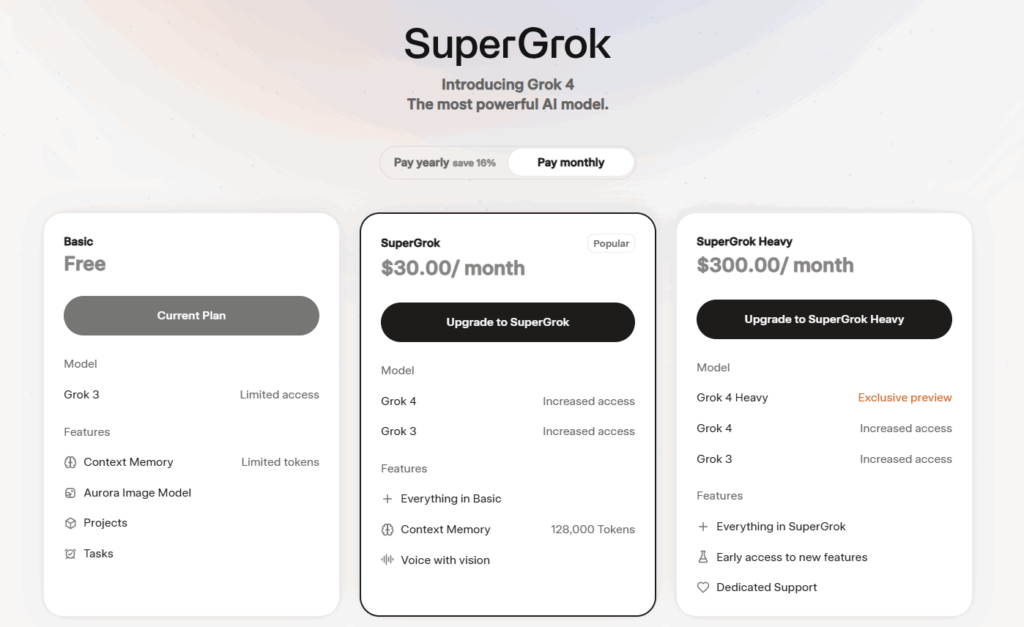
The biggest differences between Super Grok plans come down to model access, usage limits, AI agents, and media capabilities—not just speed.
Super Grok Lite: Where Most People Start
Super Grok Lite is the entry-level option. It’s more affordable, but the trade-offs show up quickly if you use it often.
You’re working with tighter limits, fewer features, and access to a more basic version of the model. It typically includes limited AI agent support and shorter or lower-quality outputs, including media generation.¹
For occasional use, it works. But if you start relying on it more, it can feel restrictive.
Super Grok (Standard): The One Most People Settle Into
The standard Super Grok plan is where things start to open up.
You get access to a more capable model (commonly tied to Grok 4), higher usage limits, and multiple AI agents that can handle more involved tasks. It also supports better-quality outputs, including improved media generation.¹
For writing, research, and everyday tasks, this tier handles most needs without constant interruptions. If you’re using Super Grok regularly, this is usually where things feel consistent.
Super Grok Heavy: Built for More Demanding Use
Super Grok Heavy is designed for users who push the system harder.
It includes access to the most advanced version of the model (often referred to as Grok 4 Heavy), significantly higher usage allowances, and a larger number of AI agents working in parallel for complex tasks.¹
It also supports more advanced media outputs and longer, more detailed responses.
But for most people, it’s more than they need. This tier makes sense when Super Grok is part of your daily workflow in a deeper way—not just something you check occasionally.
What Actually Matters When Choosing Super Grok
How Often You Use It
This is the biggest factor.
If you’re opening Super Grok occasionally, Lite might hold up. But if it becomes something you rely on throughout the day, the standard plan quickly becomes the better fit.
The Kind of Tasks You’re Running
Short prompts and quick answers don’t require much.
But once you start working with longer prompts, layered requests, or more detailed outputs, the differences between tiers become more noticeable—especially when it comes to model strength and agent support.
Your Patience for Limits
Some users don’t mind hitting a cap and coming back later. Others find that frustrating almost immediately.
Lite tends to test that patience. Standard removes most of that friction. Heavy pushes those limits much further, offering near-unrestricted use for high-demand scenarios.¹
Why This Shift Matters Right Now
Super Grok isn’t alone here.
Companies like OpenAI and Google are moving in the same direction with tools like ChatGPT and Gemini—offering different tiers based on access and performance.²
What stands out with Super Grok is how clearly those tiers are separated. The jump from Lite to standard—and especially to Heavy—is more noticeable, which forces users to think more carefully about what they actually need.
This isn’t just about pricing. It’s about how AI tools are being structured going forward.
What Most People Miss
A common assumption is that the highest tier is always the best option.
It isn’t.
For most users, the standard Super Grok plan covers everything from writing help to research and everyday use. Heavy only starts to make sense if you’re consistently hitting limits or depending on it for more demanding work.
On the other side, Lite can seem like an easy starting point—but the restrictions can show up sooner than expected.
The better approach is to match the plan to how you actually use it—not what sounds best.
What This Means for Everyday Use
If you’re using Super Grok for daily tasks—drafting content, organizing ideas, answering questions—the standard plan fits naturally into your routine.
Lite works for lighter use. Heavy is there for users who need more headroom, more agents, and access to the most advanced model.
At the end of the day, it’s less about features and more about how smoothly it fits into what you’re already doing.
Final Thoughts
Super Grok has moved from being a single tool to a set of options, and that changes how you approach it.
Lite is a starting point. Standard is where most people settle in. Heavy is there if you need more power and fewer limits.
The right choice isn’t about picking the most advanced plan—it’s about picking the one that fits how you actually use it.
Citations
- “SuperGrok Lite vs SuperGrok vs SuperGrok Heavy vs Free: All Plans Compared and Which Is the Right Plan for You.” Moneycontrol, 2026.
- Field, Hayden. “AI Subscription Models Are Becoming the Norm.” CNBC, 2025.