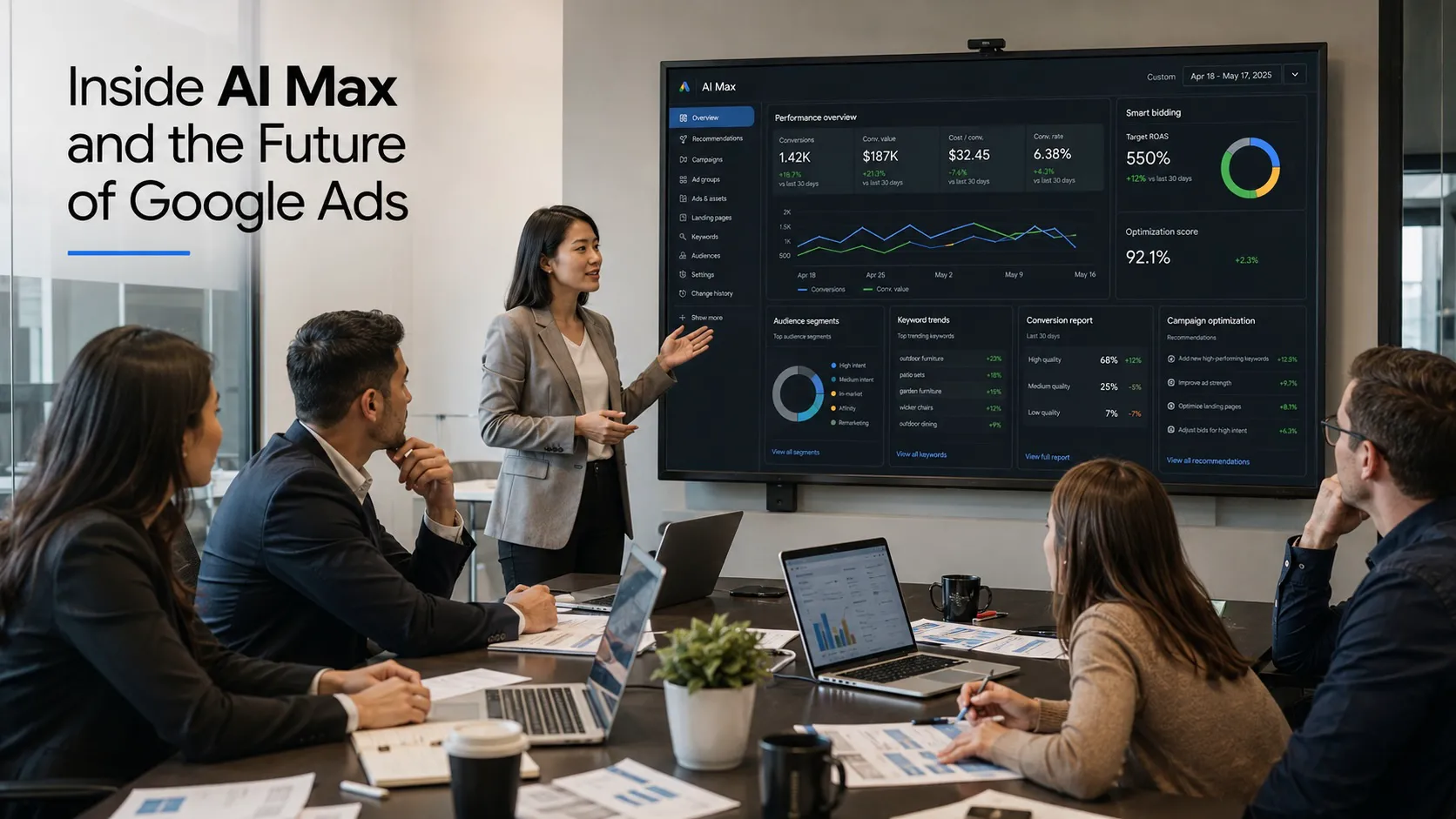
AI Max changes how Google Ads Search campaigns identify intent, generate ad variations, and choose landing pages, while Smart Bidding determines how aggressively to compete in each auction. That does not reduce the importance of PPC managers. It raises the value of people who understand business goals, lead quality, customer behavior, and performance data.
Google Ads has spent years moving deeper into automation, but AI Max signals a much larger shift in how Search campaigns operate. Instead of relying heavily on tightly controlled keyword lists, advertisers can now let Google’s systems expand targeting, adapt creative, and guide traffic more dynamically.1
For some marketers, that sounds efficient. For others, it sounds risky.
The truth sits somewhere in the middle.
AI Max can absolutely help advertisers uncover new traffic and conversions. At the same time, it changes what PPC managers need to focus on. Less manual keyword management. More oversight, strategy, measurement, and control.
What AI Max Actually Does
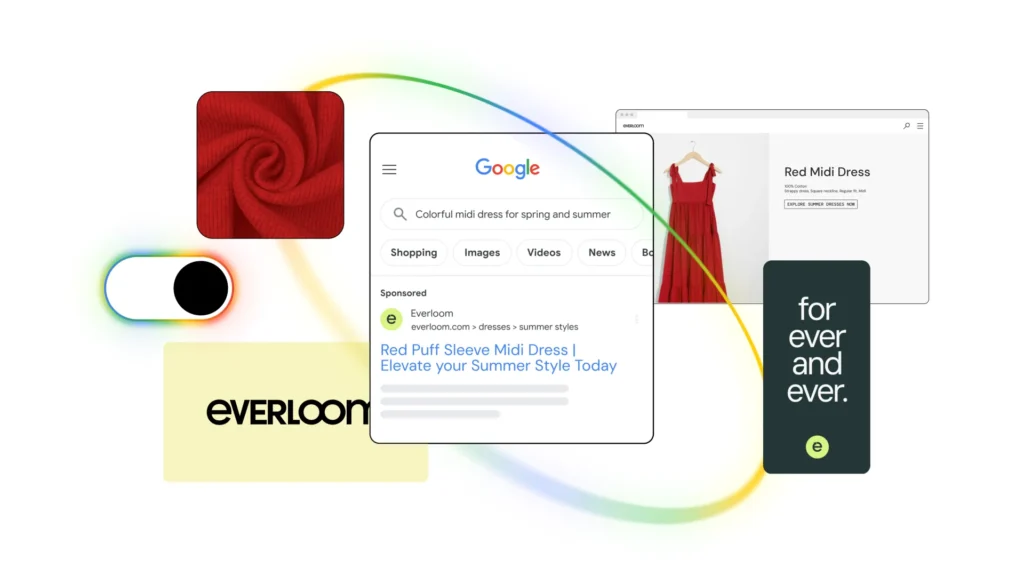
Google describes AI Max as a feature suite for Search campaigns rather than a separate campaign type.1 It combines broader search term matching, automated text customization, and landing page selection into one system designed to increase reach and relevance.
In practice, Google can look beyond exact keywords and interpret searches based on intent signals connected to ads, landing pages, campaign history, and user behavior.
Google says advertisers activating AI Max typically see 14 percent more conversions or conversion value at a similar CPA or ROAS. Campaigns still relying heavily on exact and phrase match keywords reportedly see even larger gains, averaging 27 percent.1
Those numbers explain why AI Max is getting so much attention across the paid search industry right now.
Still, increased automation creates new challenges. More reach does not automatically mean stronger business outcomes.
A healthcare advertiser may need stricter messaging controls. A law firm may care more about qualified calls than raw lead volume. An ecommerce company may prioritize higher-margin sales over cheaper conversions.
Those decisions still require people.
Where Smart Bidding Comes In
While AI Max expands targeting and creative flexibility, Smart Bidding handles the auction side of the equation.
Google says Smart Bidding uses machine learning to optimize bids for conversions or conversion value in real time through strategies like Target CPA, Target ROAS, Maximize Conversions, and Maximize Conversion Value.2
Many advertisers miss one important detail: automation is only as reliable as the data feeding it.
If every lead is assigned the same value, Smart Bidding may prioritize quantity over quality. If CRM or offline sales data never makes its way back into Google Ads, the system cannot separate weak leads from valuable customers.
The platform can optimize quickly. It cannot independently decide what matters most to a business.
AI Brief Shows Google Still Needs Human Direction
One of the more overlooked parts of Google’s AI Max rollout is AI Brief, a Gemini-powered feature designed to help advertisers guide campaign behavior using written instructions instead of relying entirely on settings, keywords, and manual structures.
Advertisers can provide context around brand positioning, audience priorities, messaging preferences, and campaign goals. Google says AI Brief gives its systems richer business context to better steer campaign performance.6
That detail matters because it quietly pushes back against one of the biggest concerns surrounding AI-driven advertising: the fear that marketers are losing control completely.
Google is effectively acknowledging that automation still performs better when humans provide context, priorities, and boundaries.
A PPC manager might use AI Brief to:
- avoid discount-heavy messaging for a premium brand
- prioritize lead quality instead of lead volume
- steer campaigns toward higher-margin products
- reduce compliance risks in regulated industries
- tailor messaging for different customer segments
In other words, AI Max may automate execution, but advertisers still need people who understand positioning, customer intent, and business strategy.
That role is becoming more important, not less.
AI Max Is Not the Same as ChatGPT, Claude, or Gemini
Some advertisers hear “AI” and immediately think about tools like ChatGPT, Claude, or Gemini. That comparison only goes so far.
Those systems are large language models designed to generate responses, summarize information, and assist with writing or research. AI Max operates differently. It sits directly inside the advertising platform and influences how campaigns target searches, build ad combinations, and route traffic.
It is much closer to operational automation than conversational AI.
That distinction matters because PPC managers are not reviewing AI Max output the same way they review a chatbot draft. They are evaluating an entire advertising system: query quality, bidding efficiency, conversion data, landing page performance, and return on spend.
Google Is Not Alone
Microsoft Advertising is moving in a similar direction.
The company announced its own AI Max for Search in open pilot, designed to improve query matching, personalize assets, and route traffic more intelligently across Bing and Copilot-powered search experiences.3
Microsoft has also expanded its broader Copilot positioning within advertising tools. In that ecosystem, Copilot acts more like an AI assistant for campaign management, reporting, and creative workflows.4
Google and Microsoft are approaching the market differently, but the direction is becoming clear. Search advertising is moving toward more automated, conversational, and AI-assisted experiences.
That shift is happening at the same time AI-generated search answers are becoming more common across the web.5
Why PPC Managers Matter More Now
The biggest misconception surrounding AI Max is that automation removes the need for human management.
In reality, it changes the kind of management required.
PPC teams still need to:
- monitor lead quality
- review search term relevance
- exclude poor landing pages
- protect brand messaging
- connect CRM and revenue data
- evaluate performance beyond platform metrics
Google says AI Max includes controls for brand settings, URL exclusions, location intent, and reporting transparency.1 Those controls matter because automated systems can drift toward lower-quality traffic if left unchecked.
A campaign may report stronger conversion numbers while sales teams complain about poor lead quality. Another may increase traffic while cutting into profit margins. Automated systems rarely explain those tradeoffs clearly on their own.
Experienced PPC managers catch those gaps before they become expensive problems.
The Bigger Shift Behind AI Max
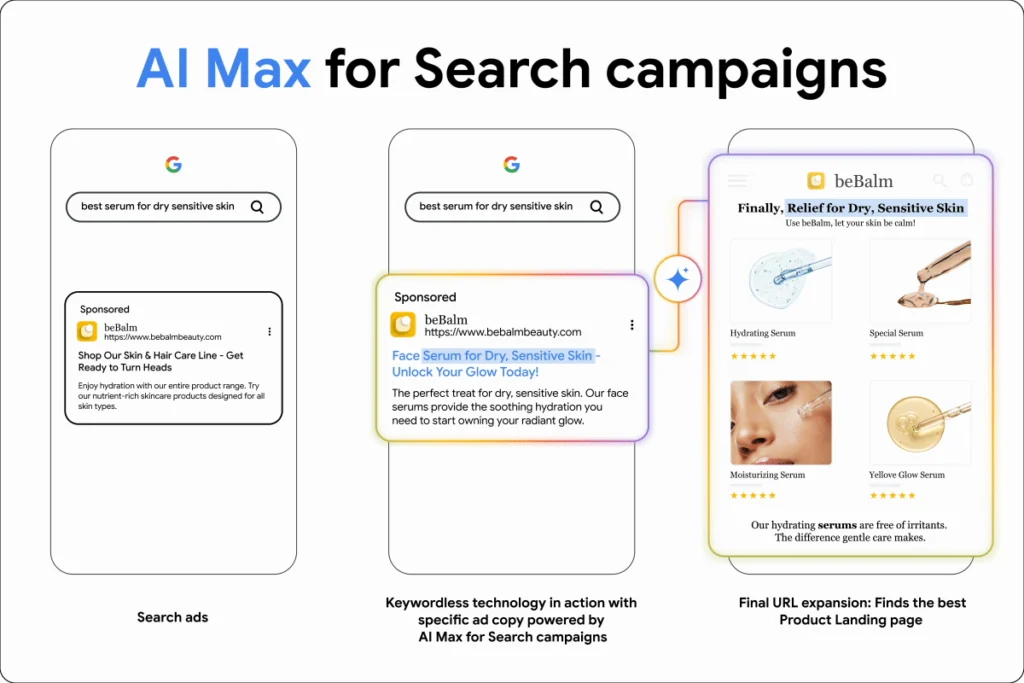
AI Max is getting attention for another reason: it reflects where search advertising itself is heading.
Both Google and Microsoft are preparing for a search environment where users rely less on short keyword phrases and more on conversational prompts, AI-generated answers, and integrated assistant experiences.
That changes how advertisers appear in search results and how platforms decide which ads to show.
For PPC managers, the role is becoming less mechanical and more analytical. The competitive advantage now comes from understanding business context, customer behavior, attribution data, and platform limitations, not just campaign setup.
Final Thoughts
AI Max and Smart Bidding are not removing PPC managers from the equation. They are changing where expertise matters most.
The advertisers that perform well over the next few years will not be the ones blindly trusting automation. They will be the ones that know how to guide it, question it, and connect it to real business outcomes.
That still requires people.
Citations
- Burdick, Brian. “Introducing AI Max for Search Campaigns.” Google Ads & Commerce Blog, Google, 6 May 2025.
- “About Smart Bidding.” Google Ads Help, Google, n.d.
- “Win across All Three Eras of the Web.” Microsoft Advertising Blog, Microsoft, 21 Apr. 2026.
- “Copilot in Microsoft Advertising Platform.” Microsoft Advertising, Microsoft, n.d.
- Vincent, James. “Google Is Giving Search Its Biggest Overhaul in 25 Years.” Android Central, 19 May 2026.
- “AI Brief.” Google Business Accelerate, Google, 2026.