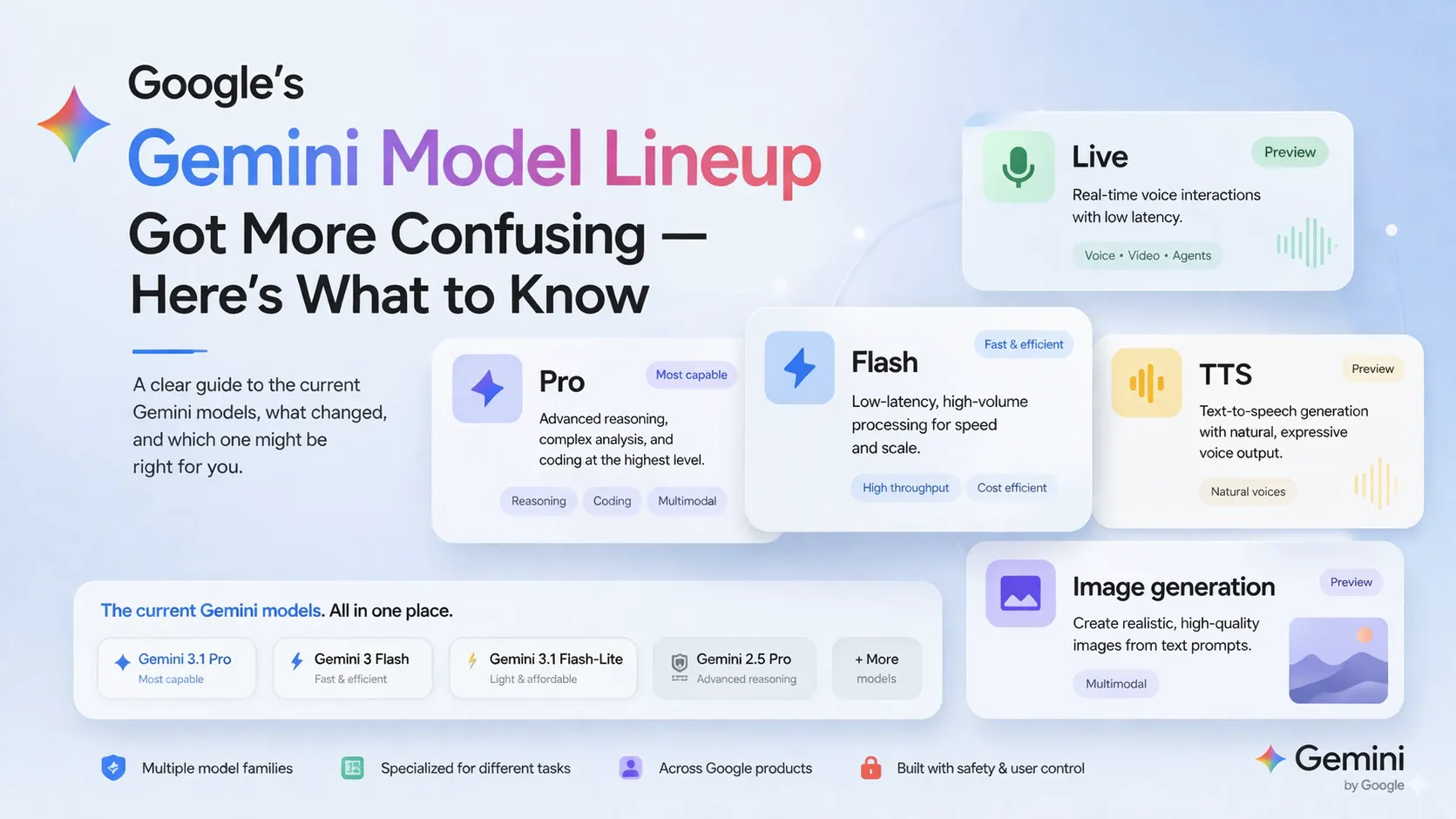
The current Gemini models are harder to keep straight than they were a few months ago. Google now has overlapping model families, task-specific versions, and different naming across the Gemini app, developer docs, and product announcements. The result is a lineup that includes Gemini 3.1, Gemini 3 Flash, Gemini 2.5, Live models, and image-focused variants all at once.
Why the current Gemini models are getting harder to follow
There was a time when Gemini’s naming made rough sense at a glance. You could look at the lineup and get a decent read on which version was built for speed, which one handled tougher work, and where each model fit.
That is no longer true.
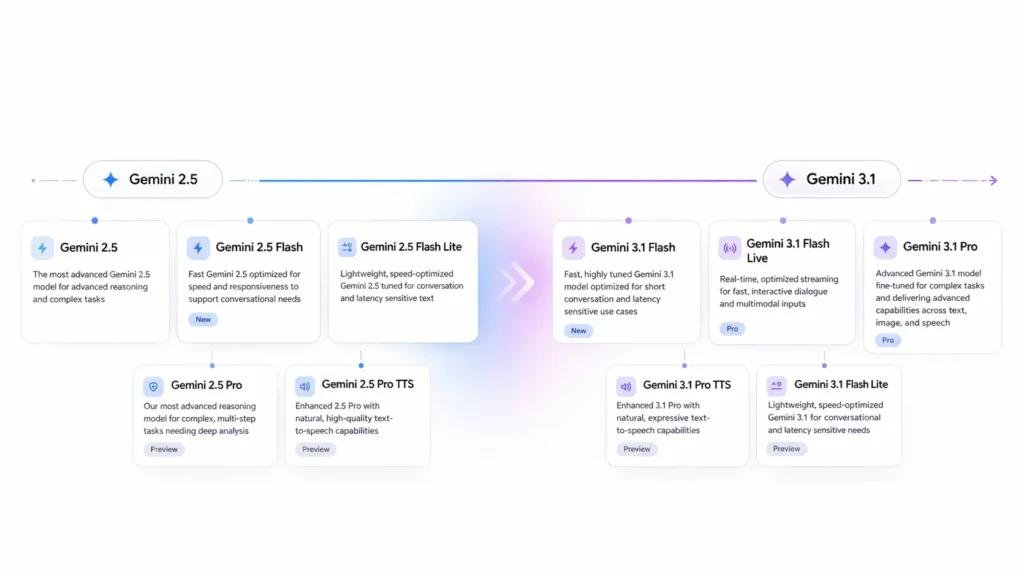
As of early April 2026, Google’s public model pages show a crowded mix of Gemini 3.1 Pro, Gemini 3 Flash, Gemini 3.1 Flash-Lite, Gemini 3.1 Flash Live, Gemini 2.5 Flash, Gemini 2.5 Flash-Lite, Gemini 2.5 Pro, plus separate audio and image-related variants.1 At the same time, some older names still show up in documentation and product language, even as newer ones roll out across the Gemini app, Vertex AI, the Gemini API, and other Google services.2
That matters because people are no longer asking only which model is “best.” More often, they are asking a more basic question: which of the current Gemini models are they even using?
What changed, and why it matters now
The biggest shift is that Google is no longer presenting Gemini as one clean ladder of options. It is turning into a broader family with multiple branches, and not all of them are easy to compare.
In February, Google introduced Gemini 3.1 Pro as an upgraded model for more demanding work and said it would roll out across the Gemini app, Vertex AI, the Gemini API, and NotebookLM.2 In March, Google also published a model card for Gemini 3.1 Flash-Lite, adding yet another layer to the lineup with a lighter, lower-cost option.3
At the same time, the 2.5 family is still featured prominently in Google’s official model catalog. That includes Gemini 2.5 Flash for lower-latency, high-volume tasks, Gemini 2.5Flash-Lite as the fastest and least expensive version in that family, and Gemini 2.5 Pro for deeper reasoning and coding.1
So yes, the confusion is real. This is not just a branding gripe. Google is actively running overlapping generations at the same time, which is exactly why the current Gemini models are drawing more attention right now.
What many people are missing
The model name no longer tells the whole story.
A growing part of Google’s Gemini strategy now revolves around specialized models, not just one all-purpose assistant. The official model list includes Live models for real-time voice conversations, TTS models for speech generation, and native image-generation options grouped under the same broader Gemini umbrella.1 That means two models with similar names may be built for very different jobs.
For developers, that may be manageable. For regular users, it makes the current Gemini models harder to read in a hurry.
The current Gemini models, explained clearly
The easiest way to make sense of the current Gemini models is to stop thinking of Gemini as one straight line and start thinking of it as a cluster of tools.”
Gemini 3.1 Pro
This appears to be Google’s top-tier model for more demanding work, including stronger reasoning, more complex analysis, and higher-end output across products.2 If someone wants the newest Gemini name most closely tied to heavier tasks, this is the one drawing the most attention.
Gemini 3 Flash and Gemini 3.1 Flash-Lite
These sit closer to the faster, lighter end of the range. Google describes Gemini 3 Flash as offering frontier-level performance at lower cost, while 3.1 Flash-Lite is positioned as a newer lightweight option in that same part of the lineup.3
In other words, these are the models built for speed, scale, and cost control more than maximum depth.
Gemini 2.5 Pro, Flash, and Flash-Lite
This is one reason the lineup feels messy: the 2.5 family has not gone away.
A lot of people see “Gemini 3” and assume the older branch has effectively been replaced. But Google’s own documentation shows that 2.5 models are still central to the ecosystem. They continue to cover several core jobs, including advanced reasoning, faster responses, and lower-cost multimodal work.1
So even if the newer naming gets the headlines, the older family is still part of the present, not just the past. That is one of the main reasons the current Gemini models feel more confusing than they should.
Live, TTS, and image-focused Gemini variants
This is where the naming gets even harder to track.
Google’s official model pages list Gemini 3.1 Flash Live Preview for real-time voice interaction, Gemini 2.5 Flash Live Preview for live audio and video agents, and separate 2.5 TTS models for speech output. Google has also tied Gemini more closely to personalized features and broader cross-product context, including Personal Intelligence and imported chat memory.4,5
That means Gemini is no longer just a chatbot brand. It is a label attached to voice tools, image tools, productivity features, and more.
Why this is getting attention right now
The interest here is not only about confusing names. It is about what those names reveal.
Google is pushing Gemini deeper into more products, more personal context, and more modes of interaction. In March, the company expanded Personal Intelligence across the Gemini app, AI Mode in Search, and Gemini in Chrome, with connected data from apps like Gmail and Photos under user controls. It also added a way for people to bring chat history and saved preferences from other AI apps into Gemini.5
That is a much bigger move than a naming refresh.
It suggests Google wants Gemini to operate less like a single destination and more like an AI layer woven into daily digital life. Once that happens, the current Gemini models matter more, because the same brand may power very different experiences depending on where you encounter it.
The drawback: clarity is slipping
There is an upside to Google’s approach. It gives the company room to launch more targeted models, tune them for different workloads, and push new capabilities into different products without starting over each time.
But that flexibility comes at a cost.
The more Gemini stretches across Pro, Flash, Flash-Lite, Live, TTS, and app-level features that do not always match the public-facing model name, the harder it becomes for users to understand what is new, what is older, and what is actually available to them. Even Google’s own materials show 3.x and 2.5 models living side by side.1,2
For everyday users, the safest takeaway is not to assume the newest-sounding Gemini label is automatically the right one for every job.
What it means going forward
The current Gemini models matter because Google is building more of its AI future around them. But the story is no longer just about which model is strongest on paper. It is also about speed, price, voice, image generation, personalization, and where Gemini shows up next.
That is why the lineup now feels more crowded, and more confusing, than before.
The Gemini name still matters. But the version number, by itself, tells you less than it used to. What matters more now is the role a model is built to play. Until Google makes that easier to understand at a glance, people will keep asking the same reasonable question: which Gemini am I looking at right now?
Citations
- “Models.” Gemini API | Google AI for Developers, Google.
- “Gemini 3.1 Pro: Announcing Our Latest Gemini AI Model.” Google Blog, Google, 19 Feb. 2026.
- “Gemini 3.1 Flash-Lite.” Google DeepMind Model Cards, Google DeepMind, Mar. 2026.
- “Bringing the Power of Personal Intelligence to More People.” Google Blog, Google, 17 Mar. 2026.
- “How to Switch to Gemini: Import Your Chats and Data From Other AI Apps.” Google Blog, Google, 26 Mar. 2026.