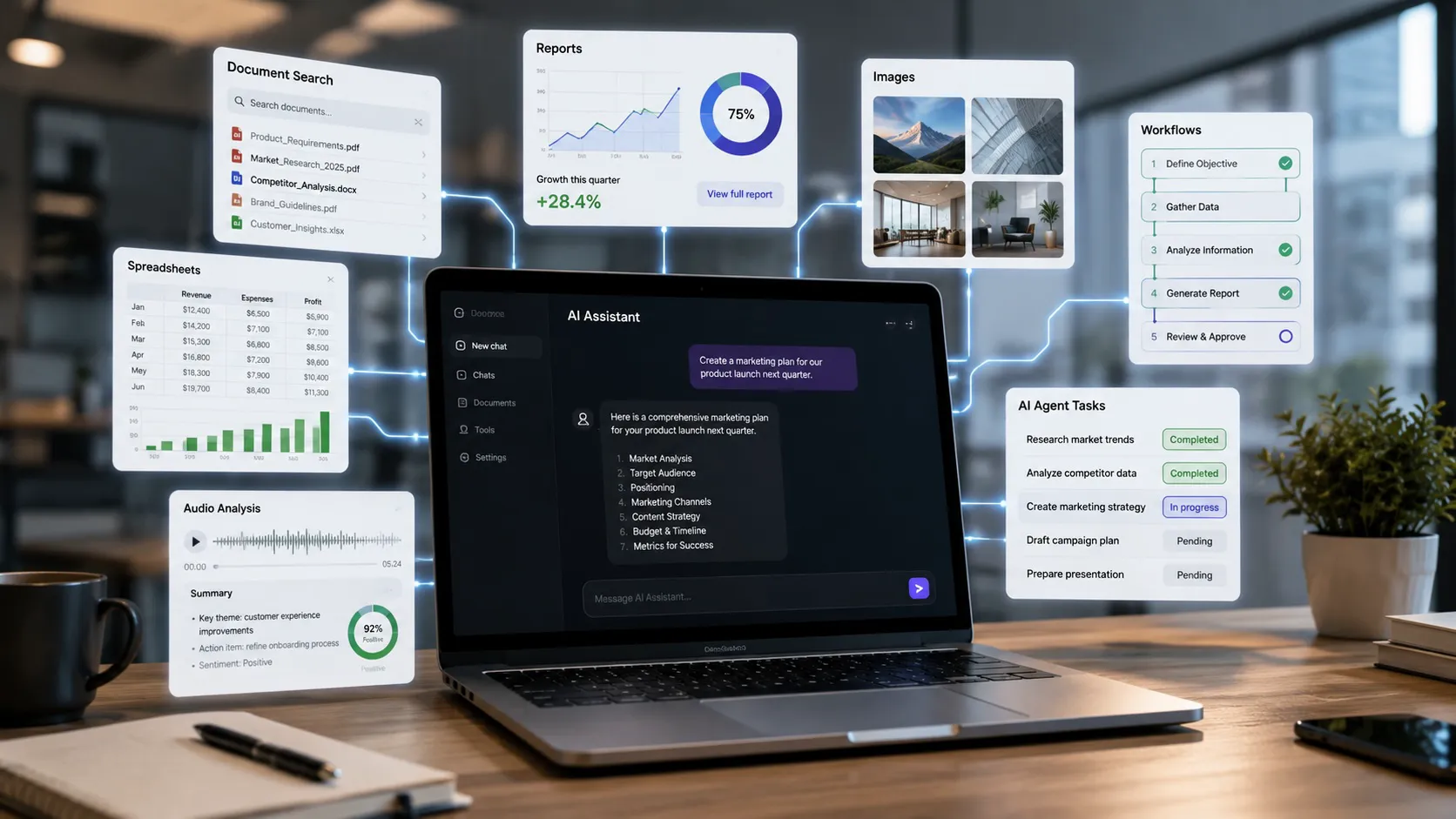
AI Evolution did not end with ChatGPT. ChatGPT made AI easy to see and use, but newer systems now search information, work with files, analyze images and audio, operate software, and complete tasks through agents. The shift is from chat-based answers to AI that can help carry work forward.
ChatGPT Made AI Mainstream
When OpenAI released ChatGPT in November 2022, it gave millions of people their first direct experience with a conversational AI system.¹ Before that, AI was already working in the background through search, recommendations, fraud detection, spam filters, maps, and photo tools.
ChatGPT changed the public view. It made AI feel immediate. You could ask a question, request a draft, explain a problem, or test an idea in a chat box and get a response in seconds.
That is why ChatGPT became a turning point in AI Evolution. It did not invent AI. It made AI visible.
The bigger story is what happened next.
AI Evolution Is Moving Beyond the Chat Box

The newest phase of AI Evolution is not only about better answers. It is about AI systems that can use tools, connect to data, handle longer tasks, and work across more formats.
OpenAI said in its 2025 enterprise AI report that ChatGPT serves more than 800 million users each week. The same report said weekly messages in ChatGPT Enterprise rose roughly eight times over the prior year, while structured workflows such as Projects and Custom GPTs increased 19 times year-to-date.²
That matters because people are not only testing AI anymore. They are working it into repeatable tasks.
ChatGPT was the front door. The next stage is the workflow.
Why This Shift Matters Now
The timing matters because AI tools are becoming more capable at the same time more people are using them for work.
In April 2026, OpenAI introduced GPT-5.5 and described it as a model that can help with coding, research, data analysis, documents, spreadsheets, software use, and tasks that move across tools.³ OpenAI also said GPT-5.5 can plan, use tools, check its work, and continue through unclear, multi-part tasks.³
That is a very different idea from the first wave of chatbots.
The earlier question was, “Can AI answer this?”
The newer question is, “Can AI help finish this?”
That is the heart of AI Evolution in 2026.
RAG Helps AI Use Better Information
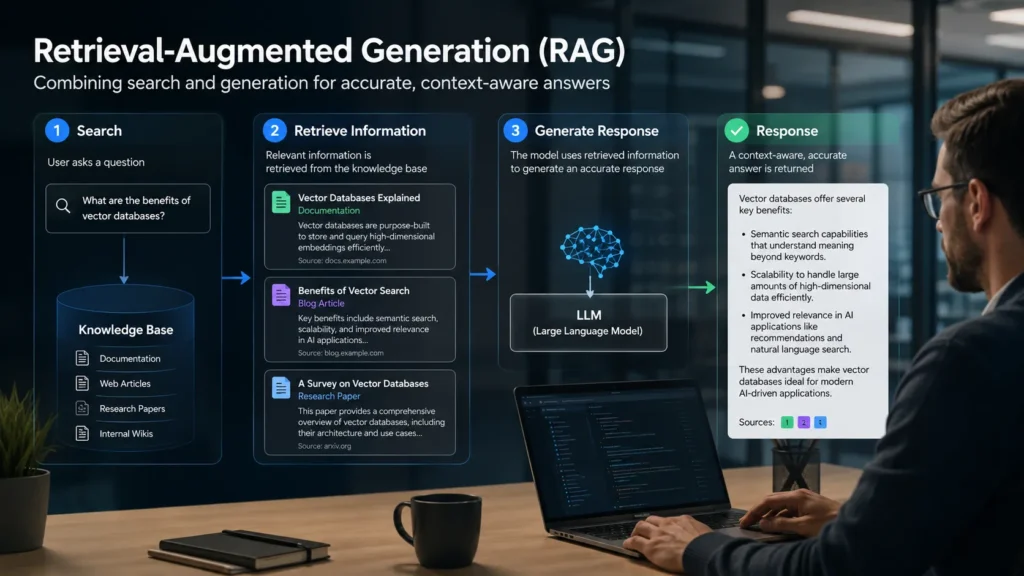
One major reason AI is becoming more useful is RAG, which stands for retrieval-augmented generation.
RAG lets an AI system retrieve outside information before it answers. That information might come from a company knowledge base, product manual, customer support page, legal policy, training document, database, or internal report.
Google Cloud describes retrieval-augmented generation as a framework that combines information retrieval systems, such as search and databases, with generative large language models.⁴ In other words, RAG gives AI a way to look at relevant information before writing a response.
This matters because many useful answers are not stored inside the model. They are stored in files, websites, databases, and company systems.
For AI Evolution, RAG is a key step because it moves AI closer to the information people actually need.
AI Agents Are the Bigger Change
AI agents are where the shift becomes even more important.
A chatbot usually responds to a request. An AI agent can work through steps. It may search, inspect files, use software, fill out forms, run code, compare options, or prepare a finished output with human approval.
OpenAI introduced new tools for building agents in March 2025, describing agents as systems that can independently complete tasks for users. Those tools included web search, file search, computer use, and an Agents SDK.⁵
Then, in July 2025, OpenAI introduced ChatGPT agent, saying ChatGPT could think and act using a toolbox of agentic skills and its own virtual computer.⁶ OpenAI also said users can interrupt, steer, pause, or stop tasks as the agent works.⁶
That last part matters. AI agents may be more useful, but they also raise new questions about permission, accuracy, privacy, and control.
What Most People Are Missing

The biggest misunderstanding is that AI Evolution is only about more advanced chatbots.
It is not.
The real shift is from one-off answers to connected systems. AI is being tied to files, calendars, email, databases, browsers, spreadsheets, code tools, images, audio, and business processes.
That makes AI more helpful, but it also makes mistakes more costly. A wrong answer in a chat is one problem. A wrong action inside a workflow is another.
This is why human review still matters. The more AI can do, the more users need clear limits, secure data access, audit trails, and approval steps before important actions happen.
Agent Tools Are Already Changing Fast
The agent space is moving quickly. OpenAI introduced AgentKit in October 2025 as a set of tools for building, deploying, and optimizing agents.⁷ In June 2026, OpenAI updated that announcement to say it was winding down Agent Builder and Evals products, while recommending the Agents SDK for code-based workflows and Workspace Agents in ChatGPT for natural language workflows.⁷
That update is a reminder that AI Evolution is still in motion. The tools are becoming more capable, but the market is also changing quickly.
For users and businesses, that means flexibility matters. It is better to understand the direction of AI than to assume one tool or feature will stay the same forever.
What AI Evolution Means for Everyday Users

For everyday users, AI Evolution means AI will keep showing up inside tools they already use.
It may help summarize meetings, review documents, explain charts, draft emails, compare products, organize research, create reports, or walk through a task from start to finish.
For businesses, the value will come from using AI in focused areas where it saves time, improves consistency, or helps people handle more information. The risk comes from treating AI outputs as final without checking them.
The best users will not be the ones who ask AI to do everything. They will be the ones who know what to delegate, what to review, and what should stay human-led.
The Bottom Line
ChatGPT was a major moment, but it was not the endpoint. AI Evolution is now moving toward systems that can search, read, listen, see, use tools, and help complete work.
ChatGPT made AI popular. The next phase will decide how useful, trusted, and controlled it becomes.
Citations
- OpenAI. “Introducing ChatGPT.” OpenAI, 30 Nov. 2022.
- OpenAI. “The State of Enterprise AI.” OpenAI, 8 Dec. 2025.
- OpenAI. “Introducing GPT-5.5.” OpenAI, 23 Apr. 2026.
- Google Cloud. “What Is Retrieval-Augmented Generation (RAG)?” Google Cloud.
- OpenAI. “New Tools for Building Agents.” OpenAI, 11 Mar. 2025.
- OpenAI. “Introducing ChatGPT Agent: Bridging Research and Action.” OpenAI, 17 July 2025.
- OpenAI. “Introducing AgentKit.” OpenAI, 6 Oct. 2025.