Key Takeaways: The New Rules for AI-Assisted Inventions
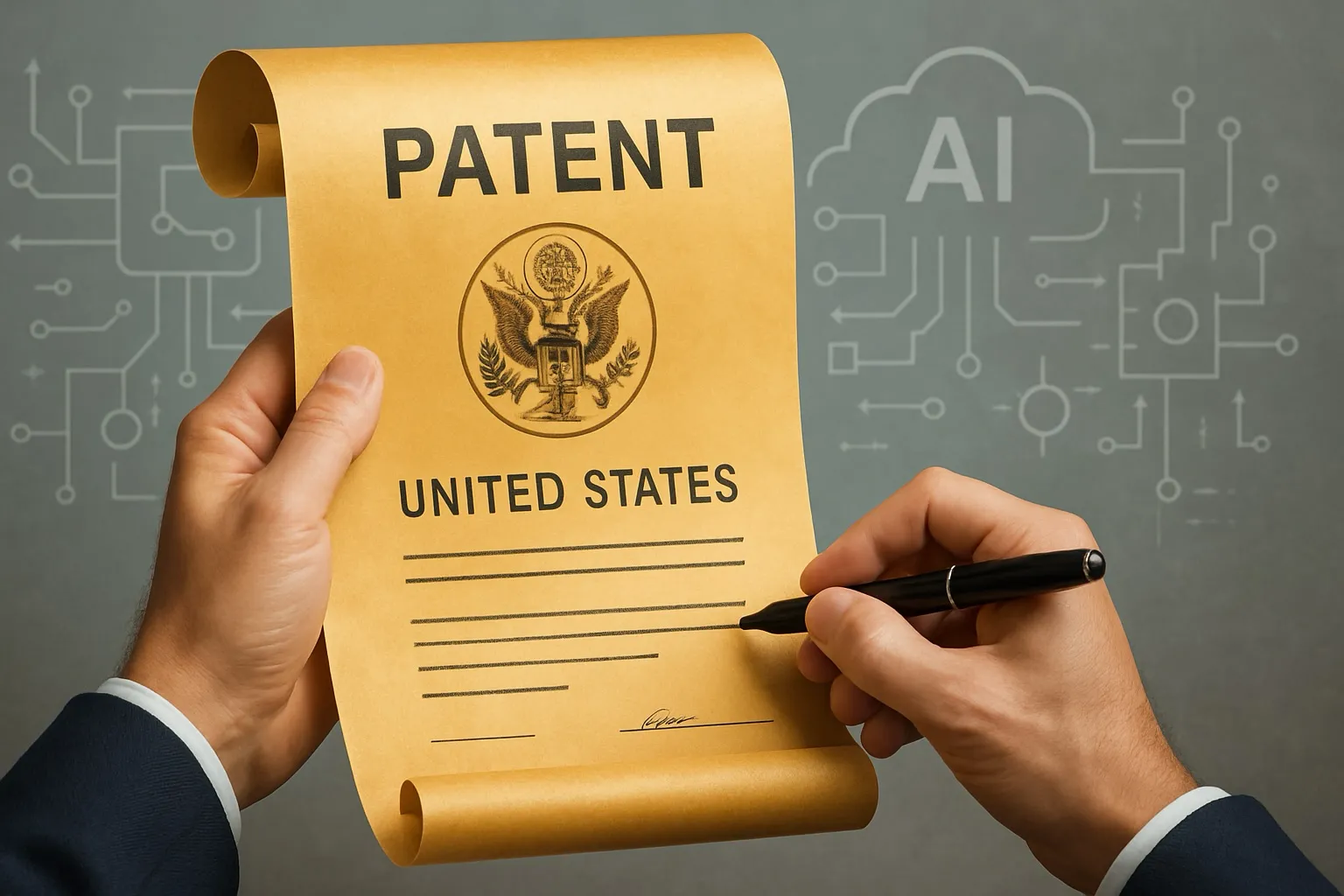
The U.S. Patent and Trademark Office (USPTO) has released clear rules for everyone creating AI-Assisted Inventions. This new guidance ensures that the traditional standards of inventorship are correctly applied to every application, no matter how much AI is involved. Here’s what you need to know fast:
- You Must Be Human: Only a natural person can be legally named as an inventor on a patent. AI systems are not allowed, no exceptions.
- AI is a Tool: Think of your AI as a powerful piece of equipment, like a complex software program or lab machine. It helps, but it doesn’t invent.
- The Big Idea Still Wins: The main rule is still conception. Did the human form the complete, definite idea of the invention in their mind? That’s what matters.
- Simple is Better: The USPTO removed the confusing old standards that made it hard to figure out how much work you needed to do. Now, it’s back to basics with classic patent law.
Part 1: Why Your AI Can’t Be an Inventor
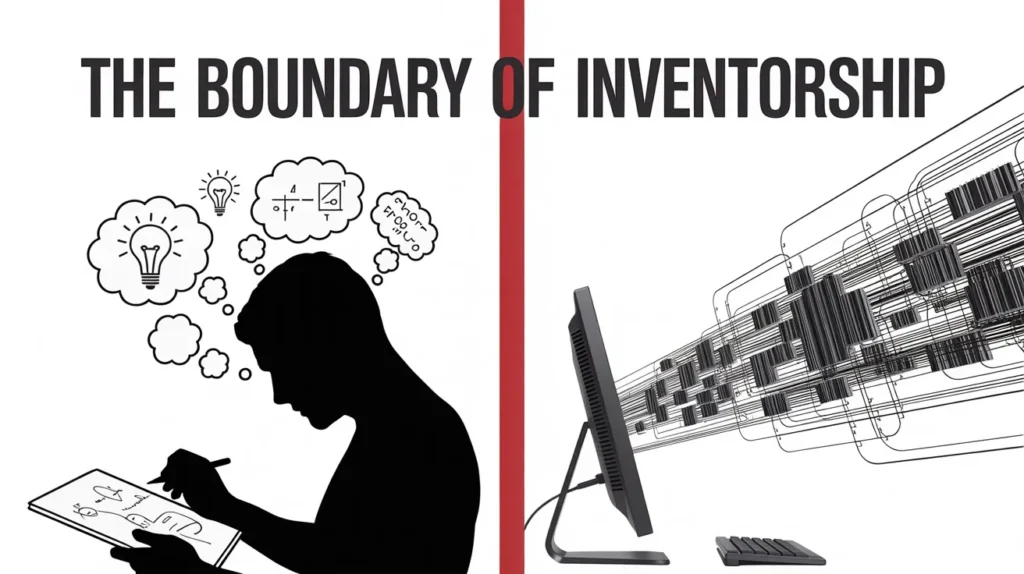
The USPTO’s stance is simple and consistent with decades of law: AI is not a person. Because patent law is designed to reward the human mind behind an invention, the statute requires the inventor to be an “individual.”
AI is Your Assistant, Not Your Partner
In the eyes of the law, advanced AI models—no matter how impressive—are simply sophisticated tools2.
Imagine you are a scientist using a powerful electron microscope. The microscope helps you see something new, but you are the one who designs the experiment, interprets the results, and understands the discovery.
Your AI system works the same way:
- It’s analogous to research databases or computer software.
- It provides services and generates ideas, but it remains a tool used by the human inventor2.
This clarification means that when you file a patent, the inventorship section must list a person (or multiple people) and cannot include the AI system’s name1.
Part 2: The Core Rule: You Must Conceive the Idea
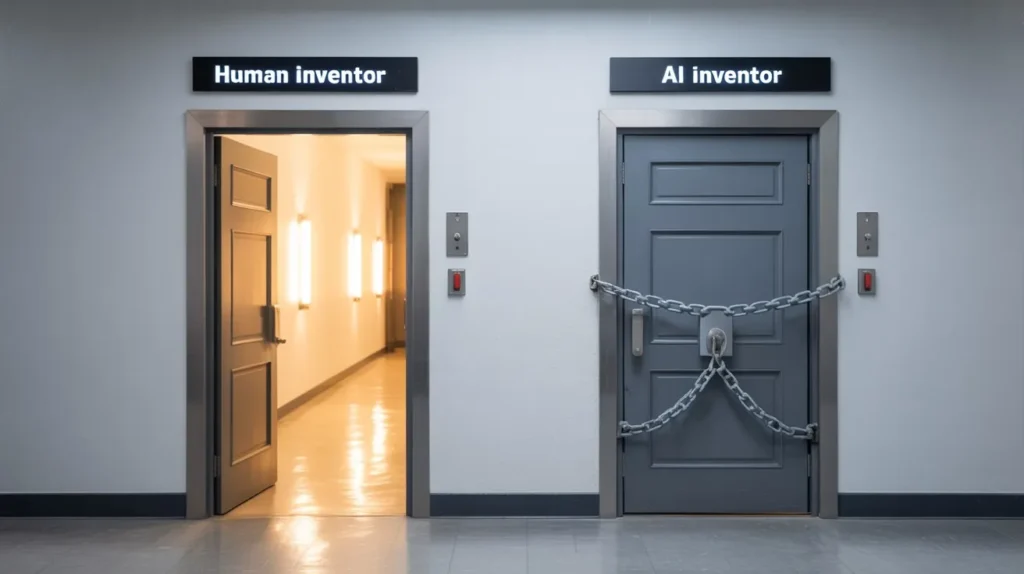
The entire decision about who is an inventor boils down to a single legal principle: conception4. This is often called the “touchstone of inventorship.”
What Conception Means in the AI Era
Conception is the moment you have a definite and permanent idea of the complete and operative invention4. It’s the full mental blueprint, ready to be built.
The new guidance confirms that this human-centric standard applies to all AI-assisted inventions1. The invention must be a definite concept in your mind. You cannot claim inventorship if your contribution was merely:
1. Providing a General Goal: Simply telling the AI, “Find a solution for X,” without a specific plan.
2. Running the System: Acting as a mere operator or owner of the AI system.
3. Recognizing Obvious Output: Looking at the AI’s results and saying, “That’s an invention,” if the result’s properties would be clear to any expert in the field.
To prove conception, you must show human insight. This usually involves providing unique inputs, defining specific constraints, or recognizing an unexpected utility in the AI’s output that was not apparent to others.
Relief from the Old Confusion
The USPTO explicitly withdrew its previous confusing approach, which involved applying a special “joint inventorship” test to AI cases3. That test was only meant for deciding if one human contributed enough to work alongside another human.
By removing this test, the process is simpler: If only one person and an AI are involved, you just have to prove that the human met the traditional, time-tested conception standard.
Part 3: Protecting Your Work: Documentation is Key
Since the legal standards are clear, your focus should be on building a strong paper trail. If your patent is ever challenged, your records must clearly prove that the human inventor conceived the invention.
You need to record your process in a way that separates your cleverness from the AI’s processing power.
| If Your AI Does This… | You Need to Document This… |
| It Generates a Design | Your unique, specific prompts or the specialized data-training strategy you used to guide the AI toward the final result. |
| It Gives You a New Compound | Your analysis and interpretation of the compound’s unexpected or non-obvious properties that made it a patentable AI-Assisted Invention. |
| You Built a Specialized Model | The human effort involved in designing, building, or training the AI system specifically to solve the claimed problem. |
Bottom line: Keep detailed records of your input, decisions, and the moment of insight where you understood the complete, working idea.
Frequent Asked Questions
Are AI-Assisted Inventions Categorically Unpatentable?
No. The use of a tool does not disqualify the human from being the inventor, provided they satisfy the conception standard1.
Is just giving an AI a general prompt enough to be an inventor?
No. If you just ask an AI, “Find me a better battery,” and it spits out a solution that’s obvious to an expert, you likely haven’t met the conception standard4. You need a definite, complete idea in your mind. If you refine the AI’s output, analyze its non-obvious properties, or design a highly specific prompt, your claim to inventorship for your AI-Assisted Invention gets much stronger.
Do I have to tell the Patent Office I used AI in my application?
Currently, the USPTO does not create a specific new rule requiring you to disclose the use of AI. However, maintaining good internal records is always the best practice in case your patent is challenged later.
What about other countries?
The U.S. rule is firm: only a natural person can be an inventor. If you file abroad in a country that allows an AI to be named (or allows a corporation to be the inventor), you must still ensure that your U.S. application corrects this and names only the human inventor(s) to secure proper claim priority5.
Citations
- USPTO. “Revised Inventorship Guidance for AI-Assisted Inventions.” Federal Register, 28 Nov. 2025.
- ExecutiveGov. “USPTO Releases Updated Guidance for AI-Assisted Inventions.” ExecutiveGov, 1 Dec. 2025.
- Sterne, Kessler, Goldstein & Fox P.L.L.C. “IP Hot Topic: USPTO Issues New Inventorship Guidance for AI-Assisted Inventions.” JD Supra, 1 Dec. 2025.
- JD Supra. “USPTO’s Revised Inventorship Guidance for AI-Assisted Inventions: What Changed, What Stayed, and What Practitioners Should Do Now.” JD Supra, 1 Dec. 2025.
- Global IP & Technology Law Blog. “New Inventorship Guidance on AI-Assisted Inventions: AI Can’t Be an Inventor, But AI Can Be a Tool in the Inventive Process (For Now…).” Global IP & Technology Law Blog, 1 Dec. 2025.