Key takeaways
- ChatGPT Ads are planned as an early test in the U.S. “in the coming weeks” for logged-in adults on Free and ChatGPT Go.¹
- OpenAI says ChatGPT Ads won’t change answers and will be clearly labeled and kept separate from responses.¹
- OpenAI says it will keep conversations private from advertisers and will not sell data to advertisers.¹
- OpenAI says we can turn off ad personalization, clear ad data, and dismiss ads with feedback.¹
- Our safest habit stays the same: share only what we’re comfortable sharing, and use the controls that exist.
ChatGPT Ads: What’s actually being tested (and what isn’t)
Ads inside a chat tool feel personal in a way that banner ads never did. We are not scrolling a feed. We are asking direct questions—sometimes about money, work, family plans, or health concerns. That is why ChatGPT Ads need clear rules.
OpenAI says it is not launching ads yet, but it plans to start testing in the U.S. “in the coming weeks” for logged-in adults on the Free and ChatGPT Go tiers.¹ OpenAI also says Plus, Pro, Business, and Enterprise subscriptions will not include ads.¹
OpenAI frames this as part of expanding access: it wants to keep a free product available and offer a lower-cost tier (Go), and ads are one way to support that.¹ OpenAI also states that Go costs $8 per month and had launched in 171 countries since August, with Go coming to the U.S. at the time of the announcement.¹
We do not need to agree with the strategy to understand the practical impact: ChatGPT Ads are designed to show up for some people, and we should know how to spot them and what controls we get.
How ChatGPT Ads are expected to appear
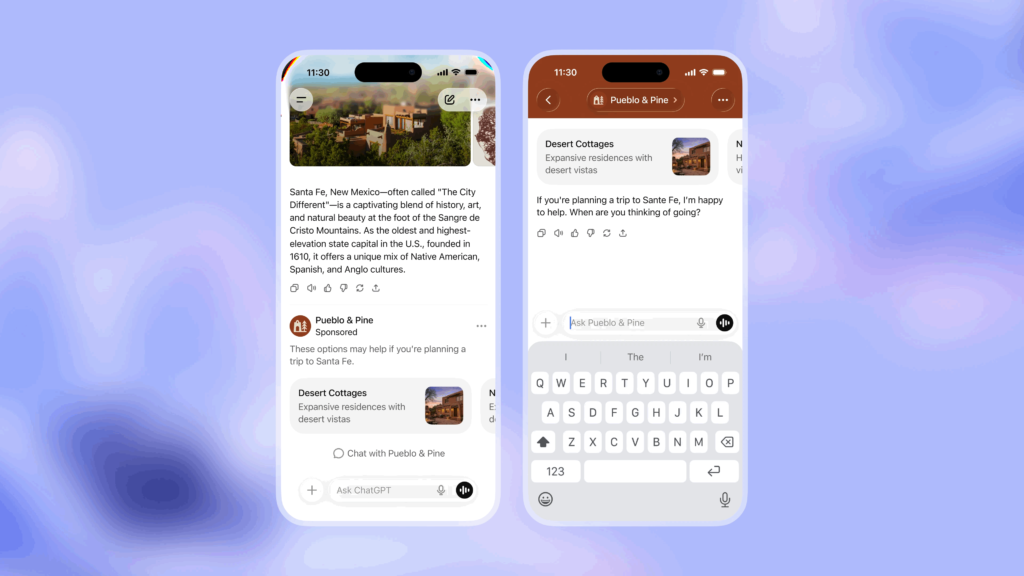
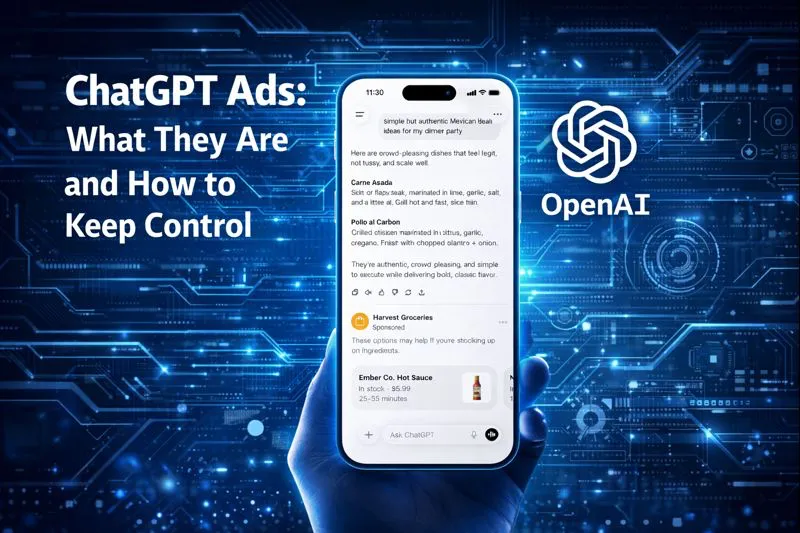
OpenAI says the first format it plans to test is simple: ChatGPT Ads at the bottom of answers when there is a “relevant sponsored product or service” based on the current conversation.¹
Two details matter here:
1. Separation and labeling. OpenAI says ads will be “clearly labeled” and “separated from the organic answer.”¹ That language is important. If we cannot instantly tell what’s sponsored, we can’t judge it properly.
2. Answer independence. OpenAI states that ads “do not influence the answers” ChatGPT gives and that answers are optimized for what is most helpful.¹ In plain terms, the promise is: the answer comes first, and the ad is a separate unit we can ignore.
A very normal scenario makes this easier to picture. If we ask for “weeknight dinner ideas,” OpenAI’s example shows a sponsored product recommendation below the response.¹ The line between “helpful suggestion” and “paid placement” must stay bright, not blurry.
Where OpenAI draws lines around ChatGPT Ads
OpenAI says that during the test it will not show ads for accounts where the user says they are under 18 or where OpenAI predicts they are under 18.¹ OpenAI also says ads are not eligible to appear near sensitive or regulated topics like health, mental health, or politics during the test.¹
That does not settle every concern people have, but it is a concrete boundary for the early phase of ChatGPT Ads.
Privacy: what OpenAI says ChatGPT Ads will not do
Most people are not asking for perfection. We are asking for basic guardrails.
OpenAI states it keeps conversations private from advertisers and never sells data to advertisers.¹ That is the headline claim behind ChatGPT Ads.
OpenAI also says we get “choice and control,” including the ability to:
- Turn off personalization
- Clear the data used for ads
- Dismiss ads and explain why, and learn more about why we are seeing an ad¹
Separate from ads, OpenAI’s Privacy Policy describes how personal data may be used to provide services, maintain security, and improve products, and it points to OpenAI’s data-use explainer for details about training and user choices.²
OpenAI’s data-use explainer adds a key point many people care about: for services like ChatGPT, OpenAI says it may use content to train models, and it explains opt-out options (including controls like “Temporary Chat,” which it says is not used for training).³
If we only take one practical lesson from all of this, it is this: ChatGPT Ads do not remove our responsibility to be thoughtful with what we type. Settings help, but good judgment still matters.
What we should watch as ChatGPT Ads roll out
We can evaluate ChatGPT Ads without needing technical knowledge. We just watch for a few real-world signals:
1) Are ads always clearly labeled?
OpenAI says labeling will be clear.¹ If we ever have to squint to tell what’s an ad, that’s a problem.
2) Do ads stay separate from answers?
OpenAI says ads will be separated from the response.¹ If we see sponsored material blending into the answer, trust drops fast.
3) Do the controls feel real?
OpenAI says we can turn off personalization, clear ad data, and dismiss ads with feedback.¹ Controls that are hard to find or hard to use are not real control.
4) Do the “sensitive topics” limits hold up?
OpenAI says ads won’t appear near health, mental health, or politics in the test.¹ That should be noticeable in practice.
A simple way to live with ChatGPT Ads
We do not need a complicated plan. We need a few habits that keep us steady:
- Treat ChatGPT Ads like any other ad: useful sometimes, but never neutral.
- Slow down before clicking. An ad can still be relevant and still be trying to sell us something.
- Use the controls: turn off personalization if we prefer that, dismiss ads that miss the mark, and clear ad data when we want a reset.¹
- Keep private details private. If a detail is not needed to get a good answer, we can leave it out.
- Consider an ad-free tier if ads feel distracting or if we use ChatGPT for sensitive tasks.¹
The bigger picture: why this is being discussed now
OpenAI’s own statement focuses on access and on protecting trust as ChatGPT Ads arrive.¹ Outside reporting adds another angle: Reuters reported—citing The Information—that OpenAI has started offering chatbot ads to dozens of advertisers, with ads planned to launch in early February, and Reuters noted it could not verify the report independently.⁵
So we have two things happening at once:
- A public set of principles about how ChatGPT Ads are supposed to work.¹
- A business push to build a new ad channel, reported through outside outlets.⁵
Both matter. Together, they explain why people are paying close attention.
Citations
- Simo, Fidji. “Our approach to advertising and expanding access to ChatGPT.” OpenAI, 16 Jan. 2026.
- OpenAI. “Privacy policy.” OpenAI, 27 June 2025.
- OpenAI. “How your data is used to improve model performance.” OpenAI, 28 Apr. 2025.
- OpenAI. “Terms of Use.” OpenAI, 1 Jan. 2026.
- Sultan, Abu. “OpenAI to start offering chatbot ads to advertisers, The Information reports.” Reuters, 21 Jan. 2026.