AI Trends 2025 came down to one big shift: AI stopped feeling like a separate thing you “go use” and started showing up inside the tools people already rely on. Costs kept dropping, smaller models got more capable, and open-weight options closed performance gaps fast—so more teams could test real workflows, not just demos.
Key Takeaways
- AI Trends 2025 was less about flashy moments and more about features people used every week.
- Lower costs and better efficiency helped AI spread across more products and teams.
- “Do the task for me” flows became more common, especially for writing, coding, and planning.
- The most influential models in AI Trends 2025 included GPT-5.2, Gemini 2.5 Pro, Claude Opus 4.5, and Llama 4.
- Trust, privacy, and “show me the results” became the deciding factors for wider rollout.
AI Trends 2025 at a Glance: The 7 Themes That Mattered
Here’s the cleanest way to understand AI Trends 2025—as themes that showed up across products, workplaces, and everyday routines.
1. Costs dropped and efficiency improved
2. AI features blended into everyday tools
3. “Do the task for me” workflows gained momentum
4. Open-weight models got closer to closed models
5. Multimodal inputs became more common (text + images and more)
6. Trust and privacy became everyday concerns
7. Measurement mattered more than announcements
What do we mean by AI Trends 2025?
When we say AI Trends 2025, we’re talking about patterns that showed up repeatedly across the year.
A trend counts when it has at least two of these:
- People keep using it after the first try.
- Companies build it into products at scale.
- It produces results you can measure (time saved, fewer steps, fewer errors).
Which AI Trends 2025 were the biggest?
This table is designed to be easy to scan—and easy for AI summaries to pick up.
| AI Trends 2025 theme | What changed | What to watch next |
| Lower costs | Running capable AI got cheaper and more efficient | More AI in standard plans |
| Built-in AI | AI moved into tools people already use | Reliability and accuracy |
| Task completion | More “do it for me” flows | Guardrails and undo options |
| Open-weight rise | Open-weight models narrowed gaps quickly | More choice, more comparison |
| Big model releases | New flagship models reset expectations | What’s “good enough” changes |
| Trust + privacy | More caution in real workflows | Company rules and training |
| Proof | Less demo, more measurement | KPIs decide what stays |
Did AI get cheaper and easier to use in AI Trends 2025?
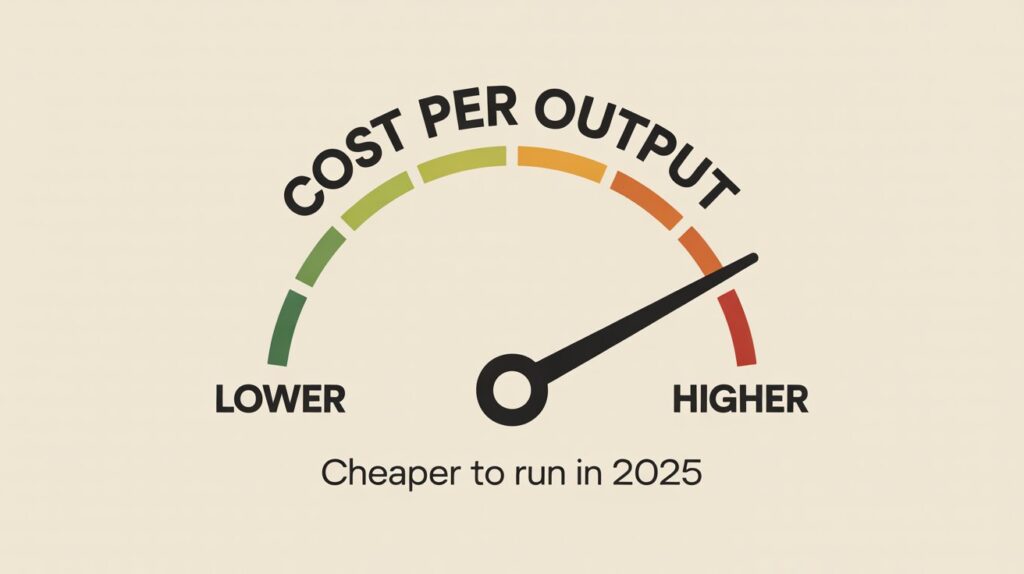
Yes—and this is one of the most important AI Trends 2025 because it affects everything else.
Stanford’s 2025 AI Index highlights sharp improvements in efficiency and falling costs over time, plus rapid progress from smaller models that brought strong performance to more use cases and price points.1
What this looked like in real life
- More AI features included in software people already pay for.
- More teams running small pilots without needing huge budgets.
- More variety in model choices, including open-weight options.
Which everyday AI features became normal in AI Trends 2025?
A defining part of AI Trends 2025 was AI becoming a background feature—not a destination.
Instead of “open an AI app,” it became:
- “Summarize this.”
- “Rewrite this to be clearer.”
- “Turn these notes into action items.”
- “Help me reply to this message.”
Most common everyday use cases
- Writing help: drafts, rewrites, short summaries
- Search help: quicker answers with context
- Image help: quick edits, background cleanup
- Planning help: simple comparisons, schedules, checklists
If you want to explain AI Trends 2025 to a non-technical reader, this is the simplest angle: AI got useful in small ways, many times per week.
Did “do the task for me” workflows grow in AI Trends 2025?
Yes. Another major thread in AI Trends 2025 was moving from suggestions to actions.
In plain terms: instead of giving ideas, the tool starts doing steps for you, like:
- creating a first draft plus a subject line
- turning notes into a meeting recap plus action items
- writing code and adjusting it based on feedback
How to judge these workflows (fast)
- Accuracy: does it get basic facts right?
- Control: can you approve before anything gets sent or changed?
- Recovery: can you undo mistakes easily?
- Consistency: does it behave the same way across similar tasks?
This is where a lot of “AI that sounds cool” got separated from “AI people keep using.”
Which significant LLMs actually mattered in AI Trends 2025?
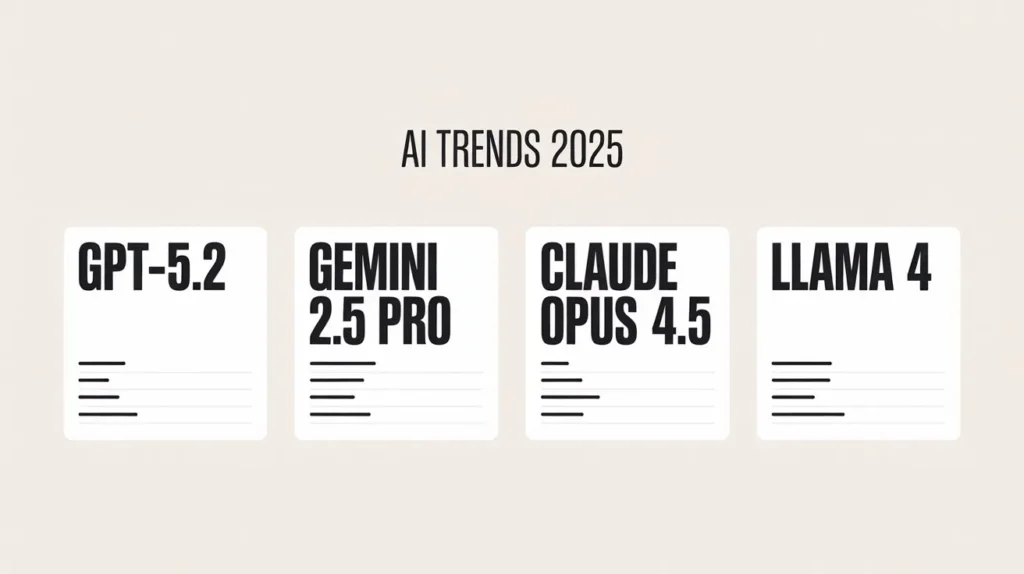
If you’re writing a year-in-review, you should name the models that moved expectations and influenced what shipped in products.
Below are the most notable models in AI Trends 2025—and why they mattered to normal users.
GPT-5.2 (OpenAI): Why it stood out
GPT-5.2 was positioned as OpenAI’s most capable model series for professional work and longer-running agent-style tasks.2
Why it mattered in AI Trends 2025
- It helped normalize “longer tasks” (multi-step work, not just quick answers).
- It pushed the bar for quality in writing, reasoning, and tool-based workflows.
- It reinforced the trend of AI moving from chat to real work output.
Gemini 2.5 Pro (Google): Why it stood out
Google introduced Gemini 2.5 as its most intelligent model at the time, with an experimental 2.5 Pro release positioned as state-of-the-art across many benchmarks.3
Why it mattered in AI Trends 2025
- It raised expectations for strong “think it through” responses.
- It reinforced the trend of AI being used across many Google surfaces and workflows.
- It added pressure on everyone to compete on quality, not just speed.
Claude Opus 4.5 (Anthropic): Why it stood out
Anthropic released Claude Opus 4.5 and positioned it as a step forward for coding, agent-style work, and everyday tasks like research and working with office files.4
Why it mattered in AI Trends 2025
- It strengthened the “AI for real work” category, especially coding and structured tasks.
- It reinforced demand for models that follow instructions well and stay consistent.
- It helped push competition around reliability and practical use.
Llama 4 (Meta): Why it stood out
Meta introduced Llama 4 Scout and Llama 4 Maverick as open-weight, natively multimodal models, aiming to bring strong performance with broader accessibility.5
Why it mattered in AI Trends 2025
- It accelerated choice: more teams could test strong models without being locked into one provider.
- It pushed open-weight ecosystems forward, including tools and hosting options.
- It supported the wider trend of multimodal use (not text-only).
AI Trends 2025: Why open-weight models became a bigger deal
One of the more important AI Trends 2025 was the narrowing gap between open-weight and closed models.
Stanford’s AI Index reports that open-weight models closed performance gaps quickly on some benchmarks over a short period, which changed how teams think about cost, control, and options.1
What open-weight options changed for real users
- More model choices inside apps and platforms.
- More competition on price and performance.
- More ability for companies to host models in ways that fit their privacy needs.
This wasn’t just a developer story. It affected what products could offer—and what they could afford to include.
What did AI Trends 2025 teach us about trust and privacy?
As AI moved into real workflows, people started asking practical questions:
- “Is this accurate enough for what I’m doing?”
- “Where does my data go?”
- “Who can see what I paste into this?”
Simple rules that help (even if you’re not technical)
- Don’t paste sensitive info into tools unless your workplace allows it.
- Keep a human review step for anything high-stakes.
- Save copies of inputs and outputs for important work.
- Use one consistent method for checking answers (sources, logs, or quick verification).
In AI Trends 2025, the winning tools were often the ones that felt predictable and safe to use—not the ones with the most features.
How to measure AI Trends 2025 in your own life or workplace
If you want an “expert” take without sounding technical, focus on simple proof.
Use these 5 questions
1. What task did AI reduce from 10 minutes to 3?
2. What task still needs a full human pass every time?
3. What errors show up repeatedly?
4. What’s the cost per month versus time saved?
5. Do people keep using it after the trial period?
That’s how AI Trends 2025 becomes a useful story, not just a list of releases.
Conclusion: The simplest way to summarize AI Trends 2025
AI Trends 2025 was the year AI became more normal—and more judged. Costs and efficiency improvements made AI easier to ship and easier to try.1 Major model releases like GPT-5.2, Gemini 2.5 Pro, Claude Opus 4.5, and Llama 4 raised expectations for quality and real workflows. And for everyday users, the final scorecard was simple: does it help me finish a task, and can I trust the result?
Citations
- Maslej, Nestor, et al. “The 2025 AI Index Report.” Stanford HAI, 2025.
- OpenAI. “Introducing GPT-5.2.” OpenAI, 11 Dec. 2025.
- Google. “Gemini 2.5: Our Most Intelligent AI Model.” Google Blog, 25 Mar. 2025.
- Anthropic. “Introducing Claude Opus 4.5.” Anthropic, 24 Nov. 2025.
- Meta AI. “The Llama 4 Herd: Multimodal Intelligence.” Meta AI Blog, 5 Apr. 2025.